Why I Wrote Get Insanely Good at AI
After years of building with AI and teaching developers, I wrote Get Insanely Good at AI. Here is why, what is in it, and who it is for.
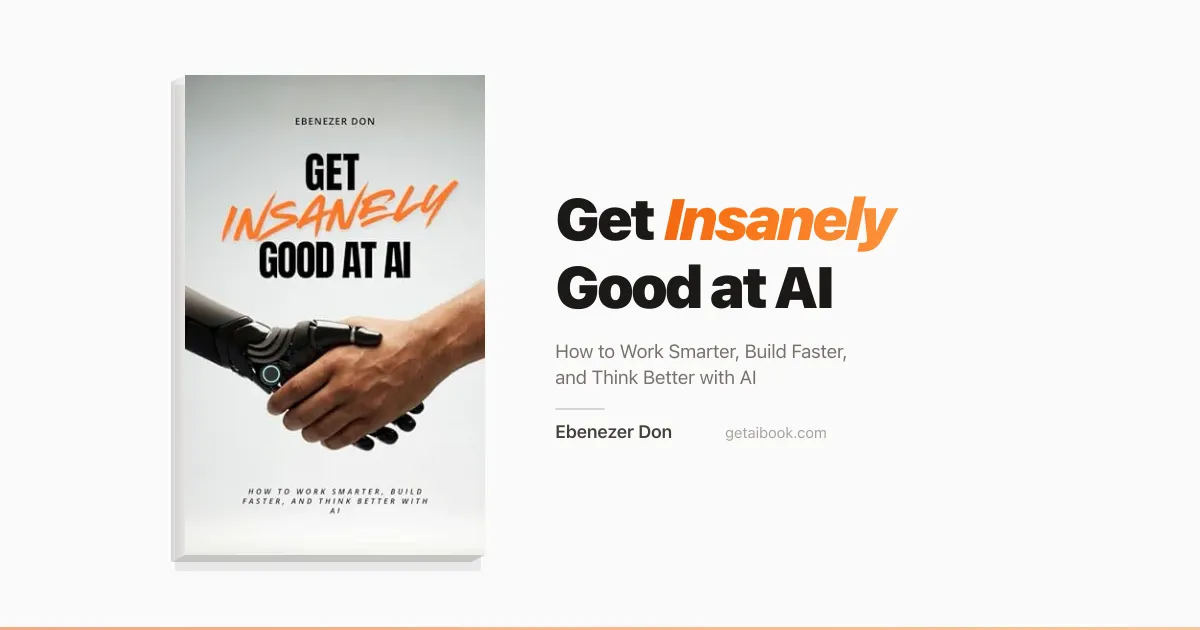
I have been writing about JavaScript, software engineering, and developer tools for years. If you have been following my work here on VIP JavaScript, you know I care about one thing above all else: helping developers build real skills, not just follow trends.
That is why I wrote Get Insanely Good at AI.
The Problem I Kept Seeing
Over the past two years, I watched the AI conversation split into two useless extremes. On one side, hype merchants promising that AI will do everything for you. On the other, fear-driven takes predicting mass unemployment and the end of programming.
Neither is helpful. And neither matches what I was seeing in my own work.
What I was actually seeing: developers who understood how AI models work were shipping faster, writing better code, and solving problems that used to take weeks in hours. Not because they had some secret tool. Because they understood the mechanics.
Meanwhile, developers who just followed prompt templates and copied ChatGPT outputs were getting mediocre results and wondering why AI was not living up to the hype.
The difference was not talent. It was understanding.
What the Book Covers
Get Insanely Good at AI is 8 chapters and 180 pages. It is structured in three parts:
Part I: How AI Actually Works. Tokenization, transformers, next-token prediction, embeddings, context windows, RAG. Not the math. The mechanics. Once you see how models actually process your input, everything changes. Your prompts get better. Your debugging gets faster. Your intuition for what AI can and cannot do becomes sharp.
Part II: How to Use AI at a Level Most People Never Reach. Prompting as structured thinking (not template-following), the AI-assisted coding workflow that actually works in production, and building products with AI as a core capability.
Part III: What Comes Next. AI agents and automation, why your hard-won experience is now your biggest advantage, and what is actually coming in AI with the hype stripped away.
If you have read my JavaScript articles, you know I do not do surface-level. This book is the same approach applied to AI.
Why This Matters for JavaScript Developers
If you are building web applications in 2026, AI is not optional anymore. Whether you are using AI-assisted coding tools, building features that call language model APIs, or just trying to stay competitive in the job market, understanding how AI works gives you an edge that prompt templates never will.
The developers who understand tokenization write better prompts. The ones who understand context windows build better RAG systems. The ones who understand how models actually generate text can debug AI-powered features instead of treating the model like a black box.
This is not about becoming an ML researcher. It is about having enough depth to be dangerous, in the best way.
Where to Get It
The book is available now on Amazon, Leanpub, and Google Play Books.
You can also read a free sample to see how it reads before you buy.
If you have found my JavaScript content useful over the years, I think you will find this book valuable. It is the same approach: clear explanations, practical depth, and zero fluff.
Check it out at getaibook.com.